Project Online is ending: what does this mean for you?
Lean Construction and the Critical Path Method: Together the Foundation of a Reliable Construction Schedule
From philosophy to post-it wall: what lean planning really is.
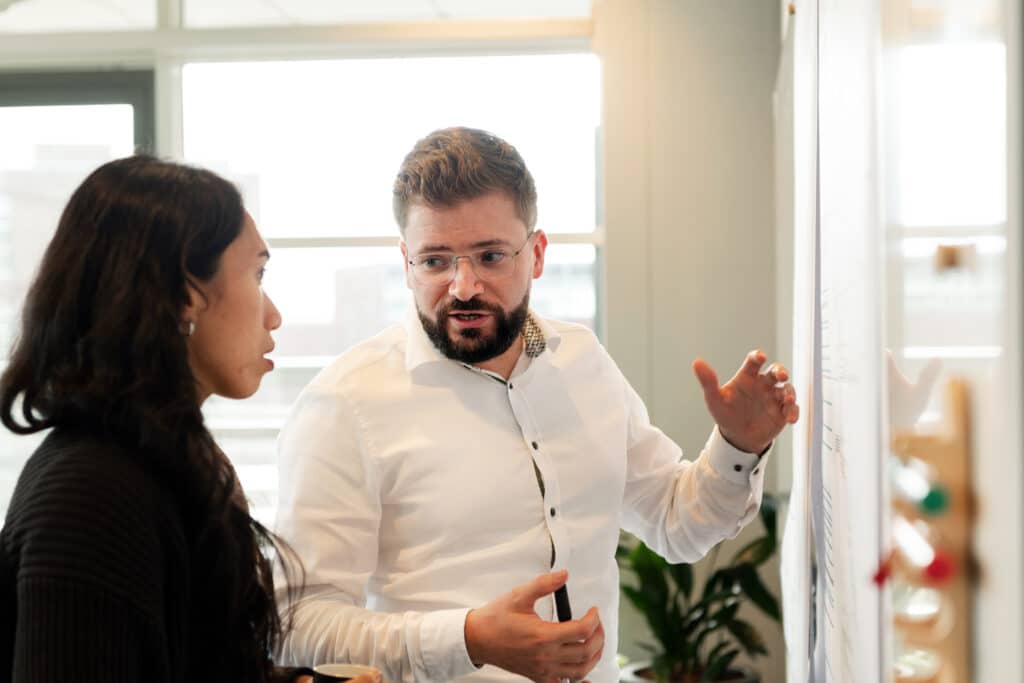
Lean planning doesn’t exist—at least not as a fixed methodology. Yet, it’s the term you hear more and more. So, what does it actually mean? Lean Construction is a construction philosophy rooted in manufacturing.[source_open]Garcés, G., & Peña, C. (2023). A review on Lean Construction for Construction Project Management. Revista Ingeniería de Construcción, 43–60.[source_close] When we talk about lean planning, we’re really talking about a process framework that gives more control to execution. Those closest to the work are involved, which allows faster responses to schedule deviations and helps reduce conflicts, constraints, and variability between activities.[source_open]Olivieri, H., Seppänen, O., Alves, T. d., Scala, N. M., Schiavone, V., Liu, M., & Granja, A. (2019). Survey Comparing Critical Path Method, Last Planner System, and Location‑Based Techniques. American Society of Civil Engineers.[source_close] The most visible manifestation of this is often the post-it walls you see in the site office.
How it works in practice:
-
Each discipline or executing party gets its own color of post-it.
-
On the post-its, they write down their activities: what needs to happen, how long it will take, and which dependencies exist.
-
Team members then place their post-its in the correct sequence on a large timeline on the wall.
-
By doing this together, dependencies become immediately visible, and the team can solve obstacles.
-
Because everyone places their own post-its, ownership is created, resulting in a plan that is supported by the team.[source_open]Olivieri, H., Seppänen, O., Alves, T. d., Scala, N. M., Schiavone, V., Liu, M., & Granja, A. (2019). Survey Comparing Critical Path Method, Last Planner System, and Location‑Based Techniques. American Society of Civil Engineers.[source_close]
Planning with post-its is a form of proactive control because the executors have direct influence.[source_open]Emblemsvåg, J. (2024). Lean project planning – Bridging Last Planner System and Earned Value Management. Elsevier Ltd.[source_close] However, since lean planning is a mindset, it also requires a behavioral shift.[source_open]Koskela, L. (1992). Application of the New Production Philosophy to Construction. CIFE Technical Report #72.[source_close] Without this change—letting go of top-down control—the post-its risk becoming a “wall of fear” that mainly causes stress.[source_open]Koskela, L. (1992). Application of the New Production Philosophy to Construction. CIFE Technical Report #72.[source_close]
Letting go of top-down control? Yes and no.
Do you really want to completely give up top-down control? Of course not. Fortunately, it’s not all or nothing. Contractually, there’s no basis for abandoning traditional planning methods entirely.[source_open]Emblemsvåg, J. (2024). Lean project planning – Bridging Last Planner System and Earned Value Management. Elsevier Ltd.[source_close]
In practice, the Critical Path Method (CPM) [moreInfo_open]The Critical Path Method (CPM) is a project planning and management technique that identifies the longest sequence of consecutive activities that determines the minimum project duration. This is the critical path.[moreInfo_close]is often unavoidable for the master schedule. Both FIDIC contracts and standard Dutch UAV GC models reference critical paths in their contractual requirements. The Last Planner System (LPS) [moreInfo_open]The Last Planner System (LPS) is a collaborative project planning method. It focuses on improving predictability by planning tasks in the short term with those who will carry them out.[moreInfo_close]provides a level of detail where you definitely don’t want the client interfering. A solid CPM schedule with a baseline provides the foundation for clear communication frameworks.[source_open]Olivieri, H., Seppänen, O., Alves, T. d., Scala, N. M., Schiavone, V., Liu, M., & Granja, A. (2019). Survey Comparing Critical Path Method, Last Planner System, and Location‑Based Techniques. American Society of Civil Engineers.[source_close]
CPM and LPS: not opposing, but complementary
CPM and LPS don’t have to exclude each other; in fact, they complement one another. Both emphasize dependencies, but at different levels.[source_open]Olivieri, H., Seppänen, O., Alves, T. d., Scala, N. M., Schiavone, V., Liu, M., & Granja, A. (2019). Survey Comparing Critical Path Method, Last Planner System, and Location‑Based Techniques. American Society of Civil Engineers.[source_close] The real value comes when the CPM activity network is structurally linked to the execution details on-site. Especially now that OPC Task has been developed, this connection is feasible.Read more about lean planning in OPC Task in this previous article:
From Kanban board to OPC Task: For efficient and insightful lean planning This way, CPM provides the strategic and contractual framework, while LPS ensures ownership and reliability in execution. The result: the gap between back office, site team, and client is noticeably reduced. LPS is also a good alternative for making progress tracking more reliable.[source_open]Emblemsvåg, J. (2024). Lean project planning – Bridging Last Planner System and Earned Value Management. Elsevier Ltd.[source_close]
Finding the right level for your project
The current challenge is finding the right planning level at which CPM and LPS reinforce each other for the team and project at hand. Together, LPS and CPM balance top-down control with bottom-up involvement. As a general recommendation, planning levels L3 or L4 are suitable, depending on the conscientiousness and maturity of the team members. From a CPM perspective, it’s advisable to always plan at a level where one person can be held accountable for each activity.
A major question before implementation is: how courageous is the team and management? Can they embrace the new mindset, and perhaps more importantly, can they take the colored post-its seriously?
Need help assessing this or setting up the link between LPS and CPM (possibly using OPC Task)? Contact BAEKEN for a free consultation.
Meer weten over dit onderwerp?
Bel met Wesley of maak een afspraak