Building on the future of accessible mobility

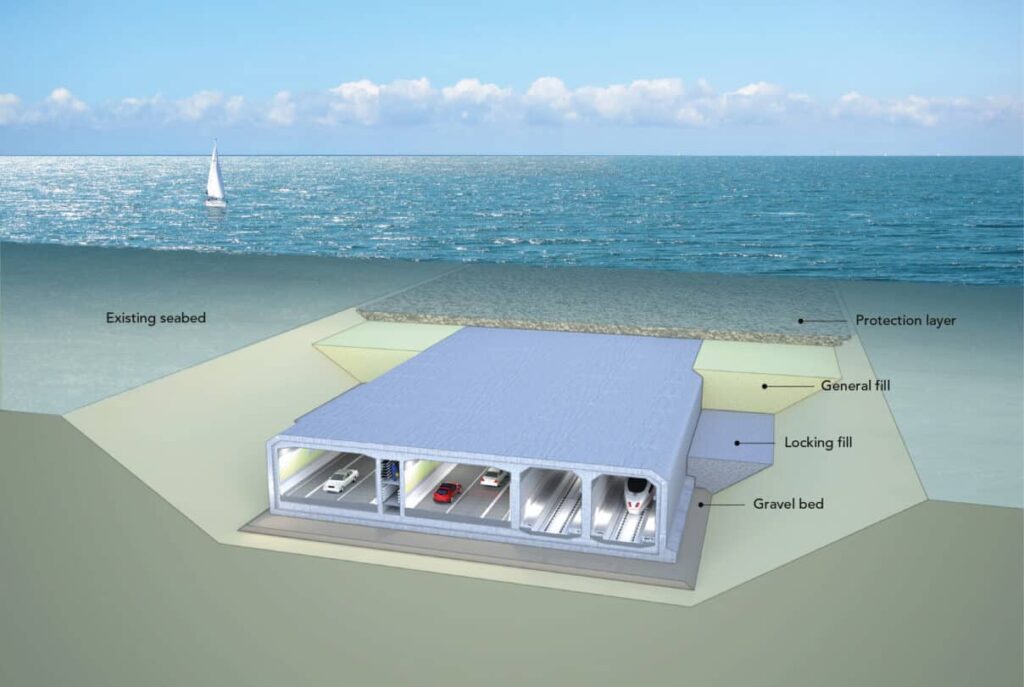
The FehmarnBelt Tunnel,[externalLink_open]Wikipedia FehmarnBelt Tunnel[externalLink_close] one of the world’s most impressive infrastructure projects, connects the Danish island of Lolland with the German island of Fehmarn. Under the leadership of Van Oord[externalLink_open]Website Van Oord[externalLink_close] and Boskalis[externalLink_open]Website Boskalis Netherlands[externalLink_close], the longest undersea road and rail tunnel in the world is being built, a technological achievement that will drastically reduce travel time between the two countries and strengthen economic cooperation.
Why was BAEKEN needed?
After the successful tendering phase, a detailed and integrated planning approach was needed during the transition to project implementation. This plan had to link processes and systems and provide an overview of all project aspects. There was also the question of applying innovative techniques, such as 4D planning, to make progress visually clear to all stakeholders involved.

How did we approach this project?
-
Setting up the structure for a flying start
In the initial phase of the project, I worked in a small core team in which I set up and helped shape the project’s processes and structures in an integrated way. By setting up a clear and coherent information management process at the front end, I created a clear and accessible information landscape. This enabled the growing project team to get off to a good start from day one and work together effectively straight away. In the process, the planning was further shaped from a tender planning to a real project planning.
-
Streamlining information and integrating processes
After setting up the basics, I focused on streamlining information management. Using Primavera and Relatics, I ensured an integrated approach where time data, object data, quality information, risks, and financial data connected seamlessly. This not only provided a solid basis for project management, but also gave the team the tools to make the right decisions at any time.
-
4D modelling for insight and guidance
To make construction progress visual, I integrated the time model with the 3D design in Synchro 4D. This approach provided a powerful overview of day-to-day progress and enabled early identification and adjustment of critical construction phases. This not only improved communication with stakeholders, but gave the team the clarity and focus to perform within time and budget.
What has been used?

Primavera P6
For detailed planning and process integration.

Relatics
For managing integrated information processes.

Synchro 4D
For visualising progress via 4D planning.

Stakeholder Management
for effective communication and collaboration

Curious if we can do something for you? Or check out similar projects.
Of bekijk andere projecten
De Knoop @ Rijksvastgoedbedrijf
When Rijksvastgoedbedrijf (RVB) acquired the former Knoop barracks in Utrecht in 2011, it had the ambition to transform
Business Park @ Aviolanda
Business Park Aviolanda houses companies and training institutes in the field of aircraft engineering and maintenance.
Sustainable energy use @ Croonwolter&Dros
Commissioned by Vattenfall, Croonwolter&Dros is realizing the heat station “De Sleutel” (The Key) near Leiden, alongside